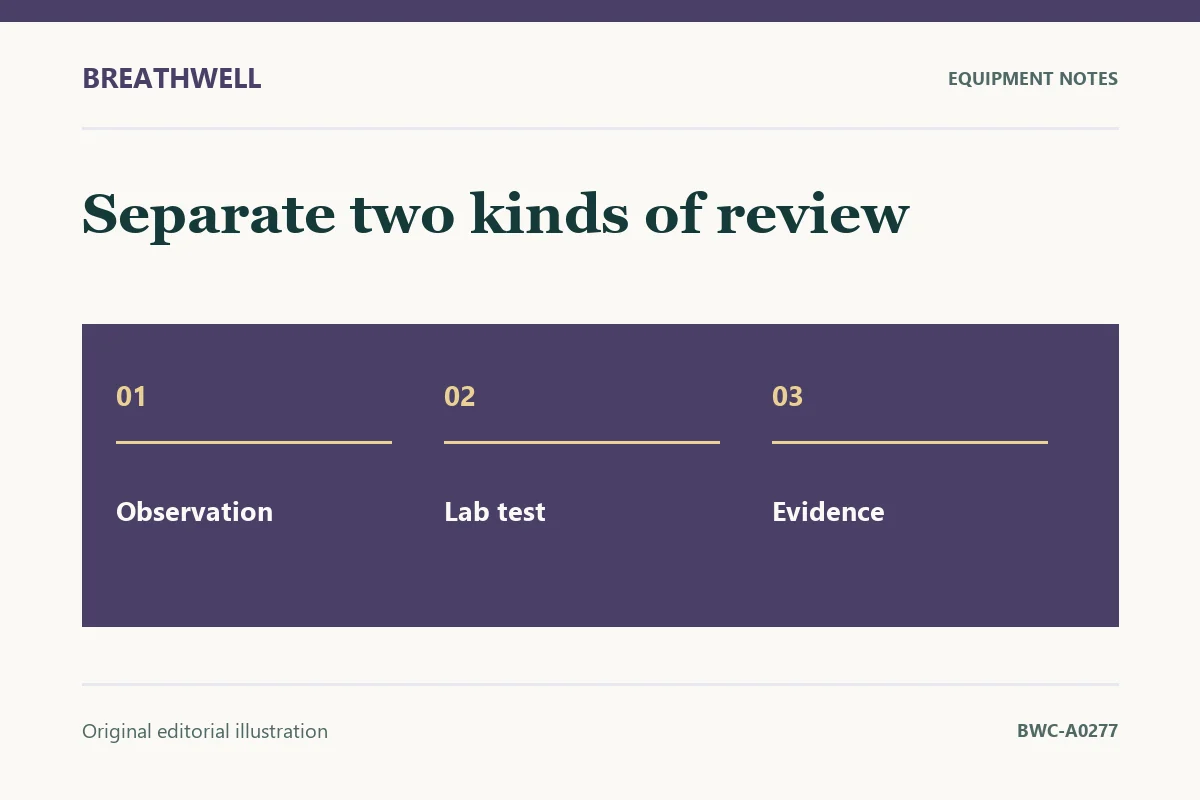
If a review says a pulse oximeter was both easy to read and accurate, look for two different pieces of evidence. An account of someone reading a demo screen tells you what that person could read in those conditions. It does not establish how close the displayed oxygen saturation was to an independent reference. The FDA’s human factors overview treats the user, surroundings and interface as separate parts of a usability question. Its March 2013 pulse oximeter guidance, section 4.1.1, describes a different question: laboratory assessment of SpO2 accuracy against simultaneous measurements from arterial blood analyzed by co-oximetry, or an equivalent method.
Check the evidence behind the sentence
| Label | What to look for | What the review can say |
|---|---|---|
| Documented feature | Exact model, source revision and page. | The manual depicts a labeled pulse field. That is not a report of anyone reading it. |
| Usability observation | Who read what, from which demo or document, under what conditions and with what help. | One observer could distinguish two labels in a supplier’s demo. This is not formal usability validation or a claim about all readers. |
| Accuracy evidence | Named device and sensor, reference method, participants, conditions and measured result. | Report the study’s result for the setup and conditions described. Leave the claim unverified if the underlying evidence cannot be checked. |
Rewrite one overclaim
Fictional review: “We tested the screen and found it easy to read.” The review actually used a manufacturer diagram and one supplier demo in bright light. A fair rewrite is: “The diagram labels the two fields. One observer identified both labels in the supplier demo in bright light without a prompt. We did not assess other viewing conditions or measure accuracy.” If the review never saw the demo itself, drop the observation and keep only what the diagram documents.
Sources and review: This is a guide to reading a review, not a testing protocol. No device was operated or tested for this article. Not yet medically reviewed.