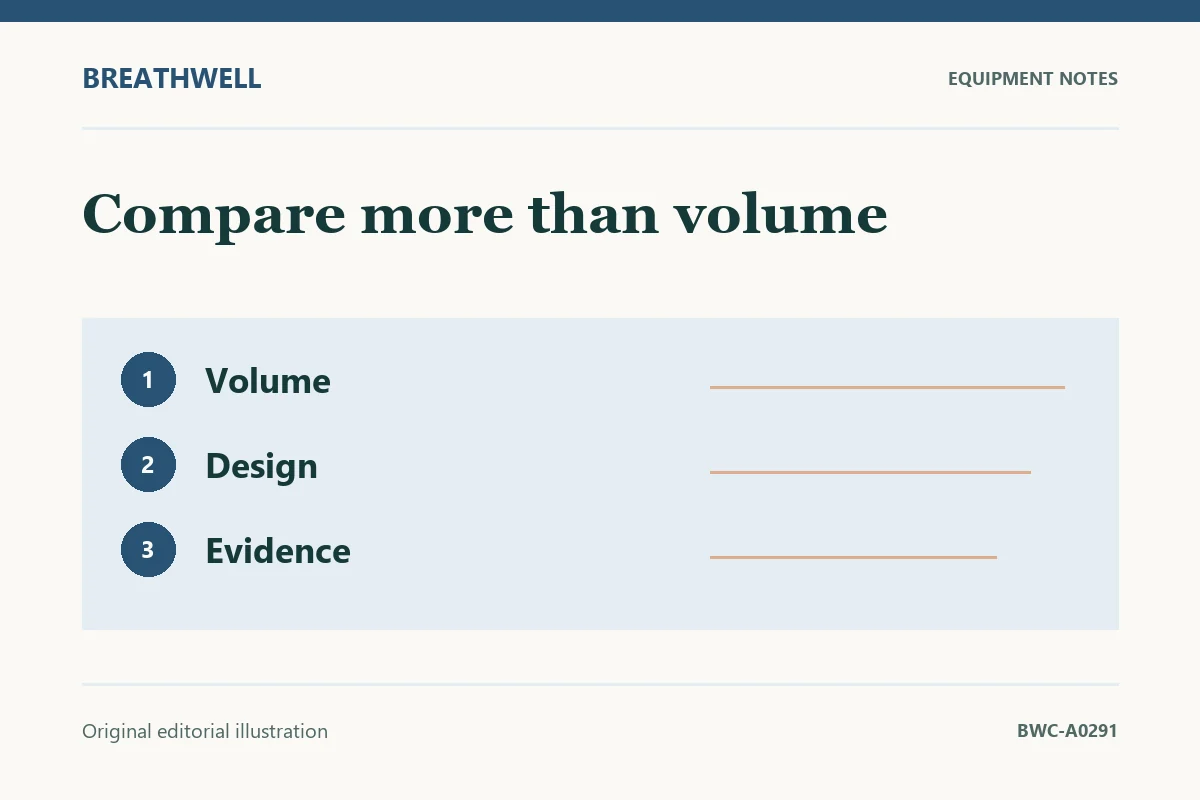
A chamber listed at 350 mL is larger internally than one listed at 149 mL in the same specification table. That does not tell you which would collect more medication on a laboratory filter, much less what a person would receive. In Csonka and Lehtimäki’s 2019 bench experiment, Tables 1 and 3, the 350 mL Babyhaler and 149 mL Aerochamber Plus differed in valve design, and the larger chamber did not show a higher median filter result in the mask-free comparison for the study’s normal simulated breathing pattern. Chamber volume was not isolated as the variable.
Read the specification and result on separate lines
- Size and design
- Write the exact model named in the source and the chamber volume in mL. Keep the valve description beside it. Table 1 gives the Babyhaler a centrally hinged valve and lists a separate outside valve. Mask volume has its own column; it is not the chamber volume.
- Configuration and measurement
- Write down the tested inhaler or medicine, whether a mask was part of the setup, and what was measured. Here the researchers used salbutamol and simulated breathing patterns for infants and toddlers. The result was the amount recovered on a filter, not a measurement in a child’s lungs.
- What the claim leaves out
- For a claim such as “larger chamber, better delivery,” note whether the comparison changed the valve, mask or chamber model too. If it did, the measured difference cannot be attributed to volume alone.
This is a reading example from the linked manuscript, not a comparison of current U.S. products or a basis for picking a size. We did not test equipment. Not yet medically reviewed.