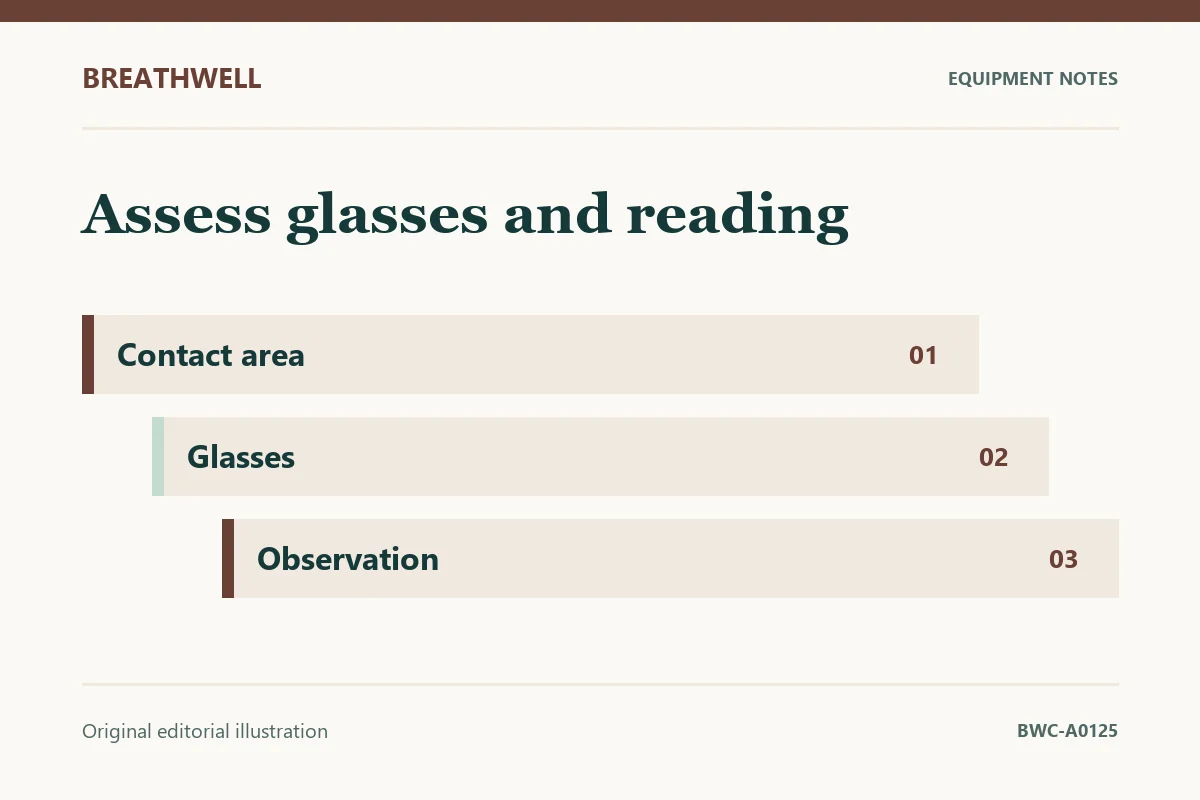
Take the glasses you actually use for reading to the fitting, along with the book, phone or other item you normally look at. A mask drawing can show what sits near the nose and temples. It cannot tell whether your frames will sit in their usual position or whether you will have the view you need.
Use the drawings to ask about specific contact points
Between the eyes: In the ResMed Mirage FX Americas guide, 628150/1, fitting figures and component key, the mask sits over the nose and has a support that extends toward the forehead. That makes the area between the lenses worth discussing if the bridge or nose pads of your glasses occupy the same space. The drawing does not establish that the two will touch.
Beside the face and above it: The ResMed AirFit N30i/P30i Americas guide, 638195/2, English component drawing and Fitting section, shows the N30i cushion under the nose and its elbow on top of the head. The frame runs along the sides of the face. A different front layout leaves a separate question about where the glasses arms sit alongside that frame. These are examples of documented layouts, not two masks you need to choose between.
Give the fitter a task to observe
- Frame contact
- Can we see whether my bridge, nose pads or glasses arms touch anything or sit differently with the mask fitted?
- Actual reading view
- Can I look at the text I normally read in my usual position? If something cuts into the view, where do I see it?
- Putting glasses on and taking them off
- Can we observe whether an arm catches or whether the glasses shift during that task? Please record exactly what happened and which mask and glasses were present.
Keep the vision task separate from the clinical fit decision. A clear view does not verify a seal, and a drawing does not verify comfort. If the two pieces of equipment interfere, ask the fitter and care team to review the options rather than changing the mask to make space.
Review status: Not yet medically reviewed.