A useful respiratory-equipment handover leaves you able to find the right directions, identify the people who can help and explain what still needs an answer. You do not need to memorize a technical manual in one conversation. Start with the actual device and the routine you will need to manage at home.
FDA's home-device question checklist recommends asking the doctor or supplier questions and taking notes. Keep those notes with the equipment information, not scattered across several remembered conversations. The purpose is to organize professional answers, not create your own settings or treatment plan.
Use one record for the handover
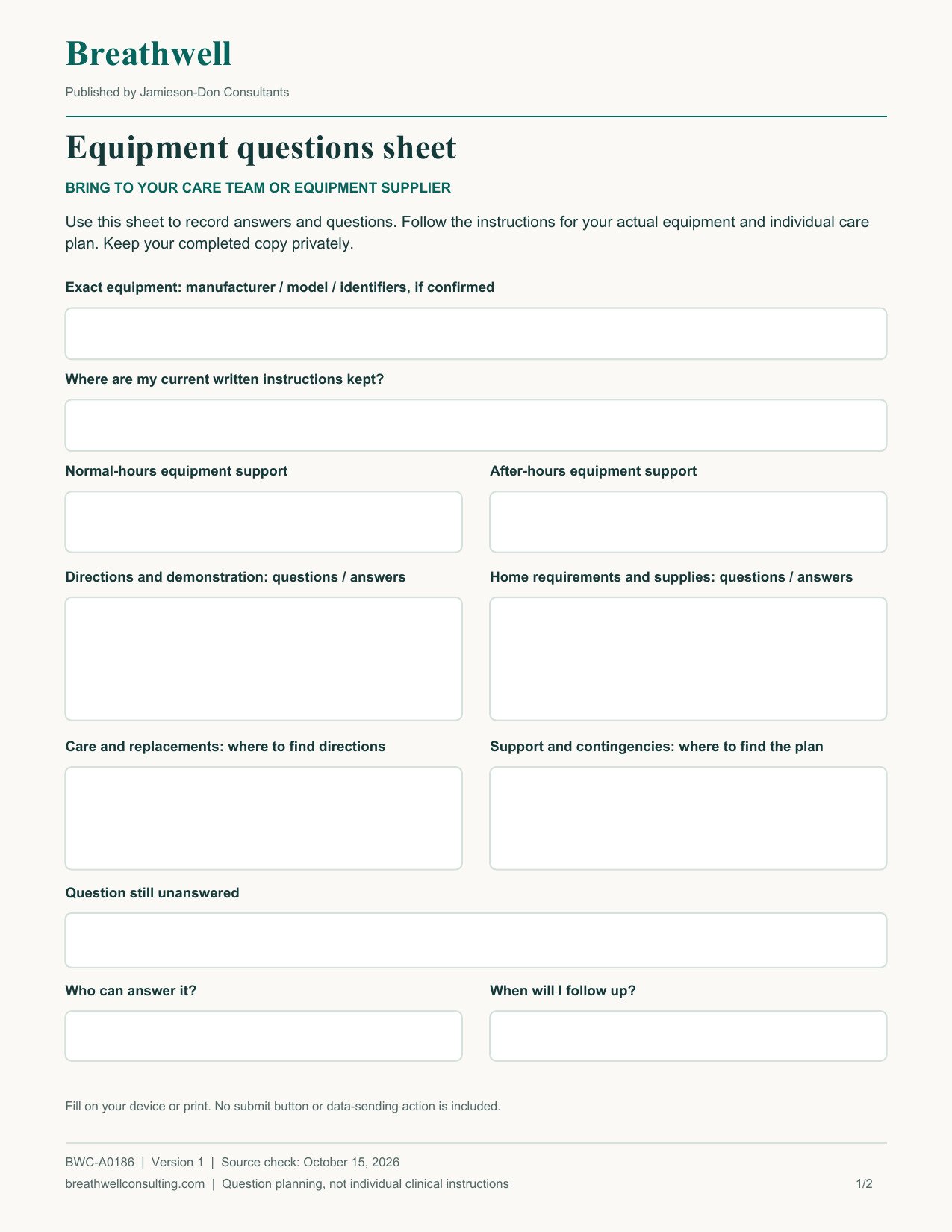
Download the Breathwell equipment questions sheet is an existing place to record answers and open questions. Keep the completed copy privately with your care information. The sheet is a discussion aid, not something you need to submit to Breathwell.
First, connect the device with its directions
Ask which manufacturer and full model designation are on the unit, which supplied components need their own instructions and where the applicable documents will be kept. If a label is hard to read or a document appears to describe another version, leave that point open for the supplier to resolve.
FDA on keeping device directions accessible recommends keeping Instructions for Use close to the device. Ask for an accessible format if the available version is difficult to read, hear or use. Knowing where the document is stored is more practical than remembering that someone once supplied a leaflet.
Make the demonstration a conversation
Ask the person teaching you to explain the actual equipment and pause at a step you cannot follow. State what is difficult: seeing a label, holding a component, hearing a message or remembering which direction applies. Those are useful teaching questions, not a reason to conceal uncertainty.
FDA on hands-on device demonstrations includes family and caregivers in device planning and demonstrations and asks for a hands-on demonstration of their ability to use the device. If someone will help at home, ask whether that person can attend and show back the taught task. Reading an article does not establish that training has happened.
Describe the home before equipment arrives
FDA's home-environment planning guidance recommends checking whether a medical device is compatible with the home. Its older general guidance discusses issues such as space and electrical access. Ask the supplier which requirements apply to the exact model rather than translating those examples into a do-it-yourself installation.
Describe any practical concern that might otherwise be missed: the route into the room, where care would be performed, or difficulty seeing or hearing the equipment. Ask which professional will assess the issue and what must be arranged before the handover is complete.
Keep care directions and support contacts together
FDA's device-care principle places operation and care with manufacturer directions. Ask which document explains cleaning, maintenance, storage and replacement parts. If two instructions seem inconsistent, ask the supplier or care team to reconcile them rather than combining them into a new method.
FDA's support-and-backup checklist recommends relevant emergency numbers, including after-hours arrangements. Record who handles equipment questions, who handles clinical questions and which contact applies when the usual office is closed. Ask the responsible team to explain alarms and error messages for the actual model.
FDA's medical-device emergency planning overview identifies power loss, moisture and contamination as matters to anticipate in emergency planning. Ask where your device-specific contingency plan is kept and which supplies or arrangements the team says it requires. This guide does not supply a backup circuit, alarm reset, oxygen adjustment or substitute treatment.
Give each unanswered question an owner
An empty answer can be useful if it leads to a named next step. Write the question, the person or service who will answer it, and when you will follow up. Keep unclear payment, rental or replacement-charge questions for the supplier or relevant insurer; the worksheet does not determine eligibility or coverage.
For example, a fictional handover note might say: “After-hours equipment number not yet confirmed. Ask the supplier before taking the device home.” That records a gap without inventing a technical instruction. When the answer arrives, note the contact or document it came from.
Bring the same record to the next conversation. Questions about medicines, readings, oxygen flow or CPAP pressure belong with the qualified people responsible for the individual plan. For related preparation, see Breathwell’s equipment questions and caregiver-skills section.
Sources and scope
FDA’s 2024 checklist and emergency overview support general planning; its 2018 home-environment page is older background, not a current model-specific installation standard. No device was tested or individual care assessed. Not yet medically reviewed.